
grooving through: vol. 18
This week: The Gaslight Anthem, Genesis, and Godspeed You! Black Emperor.

I have 254 records. Some, I bought; some, Jake bought; others were hand-me-downs.
Every week, I’m going to listen to 5 of them, A-Z, and tell you what I think. It’s music writing, but it’s also about memory, feeling, discovery, and looking back at what we love most. I’ll mostly dive into my favorite of the week and write a few sentences about the others — but anything goes, so who’s to say?
I’m not skipping a single LP: the mountain of Billy Joel records we got from my mom, the video game soundtrack, the used-bookstore impulse buys.
Let’s get spinning.
I just reviewed the latest Lykke Li record for Pitchfork; you can read that here.
The Gaslight Anthem — The ‘59 Sound (2008)
The Gaslight Anthem is my Bruce Springsteen. No further questions.
I have a funny relationship with The ‘59 Sound — I’m pretty sure that it’s the only album I listened to in college that was remotely upbeat (we’re talking amid Mitski, Frightened Rabbit, Sufjan Stevens, Elliott Smith, The National). Naturally, that made it my workout music. And because I really hate working out, I’d spend time on the elliptical maximizing my Spanish minor, translating every lyric I heard to distract myself from the effort.
At the risk of sounding old as hell… this is just some great, serious, Jersey-ass rock and roll.
On The ‘59 Sound, song after song, the band neatly drives their plane into every single explosion. They’re raucous, but still tight, determined. And they created a record that’s both deeply modern and noir, tinged with both nostalgia and urgency.
“Great Expectation’s” guitar melody leads us gently into a burst of voice and drums. Brian Fallon swings the notes within “taillights” and “last night” in a deeply satisfying, arcing meter — the following “in a dream about my first wife,” spit cleanly, brings us back onto the track. He follows almost as evenly with “Everybody leaves and I’d expect as much from you” but the latter half gets choppy, the intention direct and potent.
I kept thinking about the incredible meter and lyrical timing across the record.
Whether it’s the way “I was playing a show down the road/when your spirit left your body” sounds (and god, does it work) or the mounting polysyndeton (a device I love!) of “I always dreamed of classic cars and movie screens and trying to find some way to be redeemed” (and wow, what a list).
I’d disagree with anyone using the word “rage” about this record: I’d say “power.” Because what they have here is control and craft and finesse (see what I did there?).
They throw us into ceaseless narrative with the anchor of women’s names: Maria, Matilda, Virginia, Gail, Jane, Anna — those latter three in just one song.
Deeply literary, deeply religious, and deeply thoughtful — even deeply Dickensian, with references to Great Expectations and its character Estella, as well as A Christmas Carol’s Jacob Marley — The ‘59 Sound is all momentum. They’re racing themselves through the noise, often with a girl on their arm — running toward salvation, sure, but more so just running.
And it tied me, in our early days of friendship, to someone I really cared about.
How I got it: In sophomore year of college, I had a dear friend who also loved this band; he bought me this record and the record below as a birthday gift. He passed away a few years ago; I don’t know what happened. Though we hadn’t been in touch in a while, this made me think about him a lot.
When I first listened to it: Late high school or early college
The Gaslight Anthem — Get Hurt (2014)
I’m way less familiar with this record; it was a gift, tied to the previous one. For some context, Get Hurt is thought of as a bit of a discography outlier.
In 2018, Fallon said: “That record is always going to puzzle me … I’m not embarrassed by it, but I wouldn’t make it again.”
Get Hurt kicks off with a Nirvana-like growl, but that pares back to a more typical rock moment. And as the record proceeds, it forms a more familiar shape.
The pattern I found: Get Hurt is fascinated with starting songs a bit off-base from where The Gaslight Anthem would normally sit, then catching back up with some of its previous sensibilities as the song proceeds.
Parts of it sound surprisingly adolescent for a band that is 9 years older here than on ‘59 Sound.
“Underneath the Ground” was a standout for me on this listen, with its weary vocals and looping bass line — it almost reminds me of Brand New, in a haunting way. I’m thinking of my friend on this one.
How I got it: Same as above.
When I first listened to it: In college
Genesis — A Trick of the Tail (1976)
I know shockingly little about Genesis, except that Phil Collins and Peter Gabriel have both played a role (this record is the first post-Gabriel).
From the outset, I love the drama. And because of my earlier listening — this whole Substack concept is working, after all! — I can tell it neatly slots into the era’s prog rock, striking offbeat drums and flirting with time signatures to keep whipping you around.
I hear some touches of The Who’s Tommy in those echoed, from-above vocals.
The dreamlike lullaby “Entangled” is reminiscent of fairy tales, its pinging guitar another hallmark of the era (and neatly swapped in and out with softer fingerpicking). I appreciated them taking a breath for the ballad — and even a Beatles moment in the vocal movement of “with your consent.” There’s a lovely insistency on “nothing can hurt you at all,” and “Am I wrong to believe in the city of gold” broke through to me every time Collins sang it.
A Trick of the Tail is orchestral and inviting, almost medieval; the titular track is bouncy and meandering in a way that offers me both Beatles and even (vocally) Elliott Smith.
My mom listened to this record a lot in college. Her favorites, as she texted me, are “Squonk,” “Robbery, Assault and Battery,” “A Trick of the Tail,” and also “Ripples.” Which is pretty much the whole thing. Which is pretty cute, if you ask me.
How I got it: My mom’s copy
When I first listened to it: This might be the first time
Genesis — Spot the Pigeon (1977)
Why did I buy this! I literally don’t know! I was in college and had no records and knew my mom liked Genesis? It was definitely cheap. This is a rare EP appearance (running a tight 13 minutes) in this newsletter, to some degree because it is the size of a regular LP and sits on my shelf that way.
The AllMusic retrospective review for this EP says that “Spot the Pigeon has never been a popular or even very accessible release in the U.S. Of course, there’s a reason for this: It simply isn’t very exciting.”
I think they were pretty spot-on there.
I was writing as this record played in the background, and it passed by quickly, but my impression was mostly: Why did this need to be its own EP?
I briefly was interested in “Inside and Out,” but then realized it’s about a man who’s falsely imprisoned for rape, then set free — I don’t need that song, personally. Why even make it about a sexual crime, instead of literally any other crime, short of getting to use the weak double entrendre(ish) of “Inside and Out”?
How I got it: Webster’s Bookstore and Cafe in State College. It’s a bright translucent blue — which means it was the 2012 rerelease, so odd it’s not on streaming.
When I first listened to it: When I bought it
Godspeed You! Black Emperor — G_d’s Pee at State’s End (2021)

I think Godspeed You! Black Emperor does get a kick out of being a little bit untouchable — not on streaming, creating an album that calls for a 12” and 10” that they marked inscrutably enough that I had to Google the order, and it was clear that I wasn’t first.
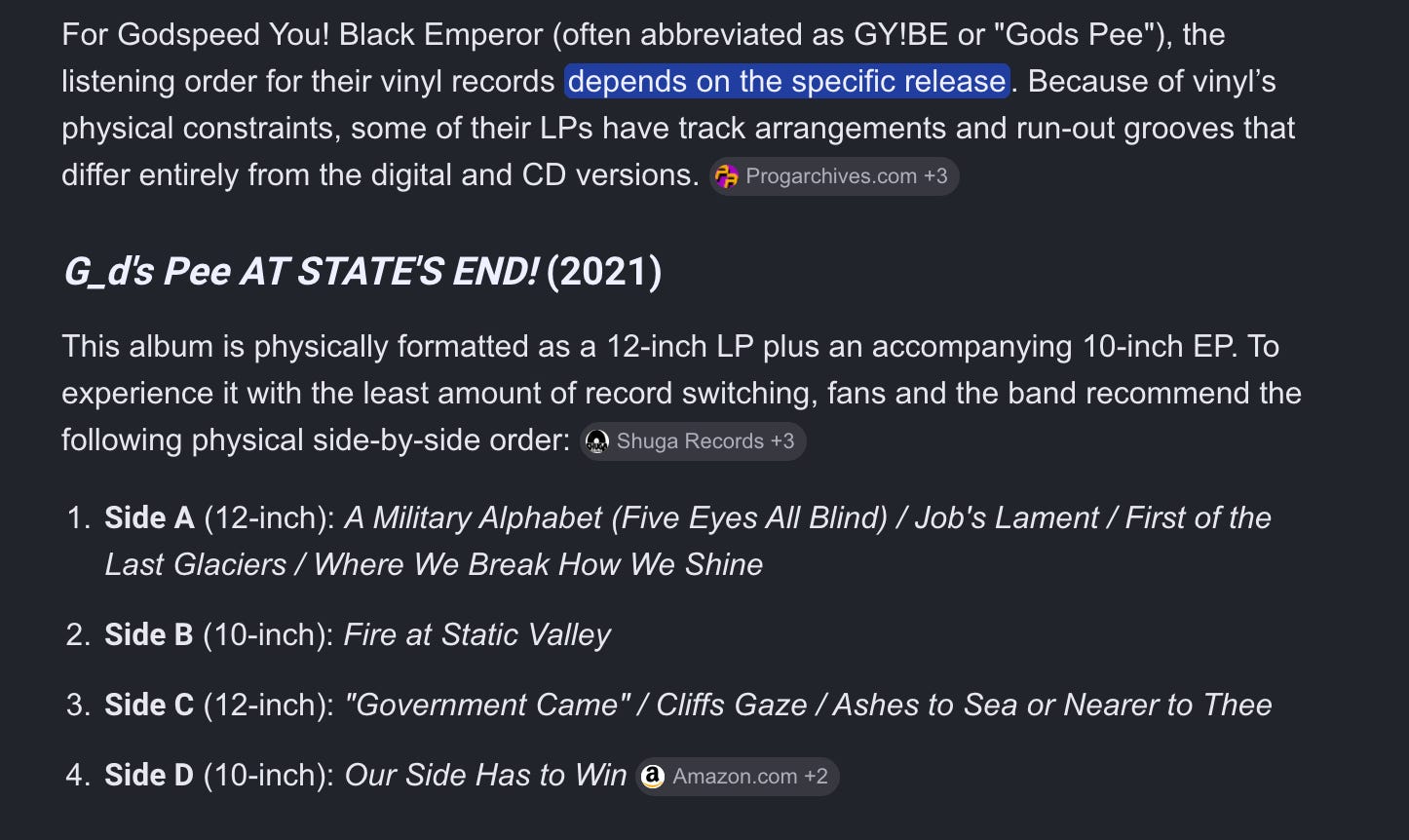
They even threw me by sticking a locked groove in there — but more on that later.
I’ve never listened to this record all the way through; I’m mostly familiar with Lift Your Skinny Fists like Antennas to Heaven, and most of my experience listening came from sitting near my brother. This record is lyric-less, and in movements, so I’m mostly just going to recall what I heard.
On G_d’s Pee, we start with discordant, garbled voices and a sustained droning, unsettling and satellite-adjacent. Then, we walk through a crackly electric guitar melody and delve into more distortion. The world around us builds darker until it morphs into almost a ‘70s prog dreamscape, with bent and whammied notes.
I love the uphill screech onto — what I imagine must be — the third track on side A, a steadily underlined but still roiling track. Here’s the tightest tie to Genesis: tighter than I would’ve imagined, knowing much more of modern post-rock and prog and less of the original innovators. This portion of the movement is grounding, powerful, and focused. I especially adore its move toward some meandering at the end, a fadeout that could be part of a Sufjan (orchestral era) finish.
Godspeed could build a whole world around you, if they wanted to. They’re never aiming for cacophony here, even when yells come — there’s always construction and intention.
The first track on Side B of the 12” has a gorgeously triumphant build with almost a winding progression that builds to a cinematically beautiful ending, clanging church bells and heavenly final notes — but with the locked groove, that beauty over-sustains. It loops long enough to feel uncomfortable, like a warning.
The last side of the 10” has Yiddish printed on the label; it reads “we will outlive them.” It’s tied to Polish Jews in Lublin during the Holocaust. It’s a plea for protection.
G_d’s Pee is obsessed with surveillance, static, justice, isolation (a list of demands came with the album).
It throws you deep in the desert, looking up at endless inky sky, knowing there’s something more brewing around you, but being certain of the chasm you’re already part of.
How I got it: Jake bought it
When I first listened to it: In full, now