
grooving through: vol. 14
This week: Earth, Wind & Fire; Richard Edwards; Electric Light Orchestra; Emerson, Lake & Palmer; and Erykah Badu.

What a week! Of things I’ve never listened to! Don’t hold it against me.
I have 254 records. Some, I bought; some, Jake bought; others were hand-me-downs.
Every week, I’m going to listen to 5 of them, A-Z, and tell you what I think. It’s music writing, but it’s also about memory, feeling, discovery, and looking back at what we love most. I’ll mostly dive into my favorite of the week and write a few sentences about the others — but anything goes, so who’s to say?
I’m not skipping a single LP: the mountain of Billy Joel records we got from my mom, the video game soundtrack, the used-bookstore impulse buys.
Let’s get spinning.
Earth, Wind & Fire — I Am (1979)
Here we go! The start of I Am might as well be the opening of a Broadway show in its grandeur. I first thought of The Wiz when “In the Stone” began — turns out the two were contemporaries. And all three writers on the song (two very much so) were involved in Broadway during their careers.
“After the Love Has Gone’s” communal refrain “Oh, after the love has gone” offers yearning that’s reflective, gentle — not tormented, like we mostly get in lost-love songs now. I also love how the whistle-y chorus vocals get split neatly off by a single, clear voice on the verse. The shared pain of love lost goes quiet for the leading individual story.
Then “Boogie Wonderland!” A lot of songs tell us explicitly to dance, and this one works on me. Philip Bailey’s vocal is unshakably suave and sultry, and I especially appreciate The Emotions’ appearance.
Earth, Wind & Fire is great at bombast, and they’re great at contrasts.
There’s something so cosmic about Earth, Wind & Fire’s disco, so inviting and psychedelic. As I listen, I’m just thinking about my mom, and events where we’d hear these songs, and her bobbing along to them in the car and singing along.
How I got it: My mom’s copy
When I first listened to it: Right now
Richard Edwards and the Velvet Ocean — The Soft Ache and the Moon (2020)
In middle school, I was very much hung up on Margot and the Nuclear So & So’s (whom we’ll talk about more when we hit “M”). But I haven’t looked into frontman Richard Edwards’ solo work much — in fact, I only have this record because he sent it my way.
Something deeply admirable on The Soft Ache and the Moon: Edwards’ willingness to step aside, to let other vocalists take his tracks in their hands. Erin Rae and Karen O enter the album with beautifully languid vocals, every moment careful and considered.
“Soft ache” is a deeply appropriate name — the gently expansive tracks fill the room with intention. The record’s glossed, everything slightly underwater, something to sink into.
I’d like to give it another spin, another five spins, because though it melted to the background of my workday, I know there’s a lot of heart there.
How I got it: In 2022 or so; I tweeted about slight skipping on a very limited Margot and the Nuclear So & So’s record — Richard saw my tweet, sent me a new one, and (I think as a general kindness, but maybe because he spotted that I was a music writer) sent me some of his other records too. This LP is clear.
When I first listened to it: Right now
Electric Light Orchestra — Out of the Blue (1977)
I know the ‘70s mostly through a folk and David Bowie lens, and I think this is an important entry for me to understand history a little better.
Something that’s been so utterly fun about listening through our collection — including a number of hand-me-downs — is clicking in a little bit more of predecessors and successors.
It’s like when you turn a corner in a newish city and suddenly realize you know where you are: you’ve connected a new segment on your mental map.
The bouncy rock on Out of the Blue bridges The Beatles and The Beach Boys all the way toward ‘00s Arcade Fire and even some ‘10s indie pop with its united vocals and experimental instrumentation. I hear Queen when they chant; I heard the world music Paul Simon prefers.
The glitchy, cosmic “Steppin’ Out” hearkens to Pink Floyd — a meandering rock ballad tipping toward prog — as well as David Bowie’s “Space Oddity.” And it drops the line “like a rolling stone” heavily, intentionally.
I was most curious about “Standin’ in the Rain,” a funky (albeit minor-keyed, almost spooky) pop song, where what I’ll call a “chaos organ” tramples across. And we have to mention “Mr. Blue Sky,” a song that I’ve again and again mistaken for a Beatles B-side. What a shame: an iconic song that sounds so quintessentially like someone else.
On Out of the Blue, the blended vocals and the combo of classical and pop work for me — but I’m just not sure what this record wants to be.
It’s great to think of references, to hear history in music. But I couldn’t catch the band. I’ll come back to it.
How I got it: It’s a hand-me-down. I think it’s from Jake’s family friends.
When I first listened to it: Right now
Emerson, Lake & Palmer — Trilogy (1972)
“The Endless Enigma, Pt. 1”: Amid ambient calls, scampering, low piano reminds me of howling wolves before a chase, or a cartoon character all-too-aware of danger. Then, we’re slammed with a zukra (think: bagpipe), and the piano breaks out into a gallop. There’s a lot of melodrama. On its own, it could be Looney Tunes soundtracking.
After all that instrumental preface, the vocals, sung over near-silence, don’t feel earned. What I hear is an attempt to mine the softness of a Simon & Garfunkel song and throw it headlong into a brick wall of Tommy-style opera rock.
I can’t grasp Emerson, Lake & Palmer’s approach on Trilogy’s first track — I get what they’re going for with the rapid time signature changes and tonal shifts and their loud/soft play, but the pacing just feels punishing.
I can’t get on the train. And usually, I can. I absolutely appreciate prog risks; I just wish I believed in their intentionality more.
I will say that “The Endless Enigma (Part 2)” feels instantly more honest. But I wonder how all the album’s songs interplay. How does it fit with tonky “The Sheriff”?
On Side 2, I settled in a bit more. My favorite track, “Trilogy” starts with floaty piano and soft vocals, akin to Jon Brion’s soundtracking, then gives way to a comprehensible chaos. I feel throttled back and forth, the drums a frenetic pulse underneath me, the horns a foothold, a way to see we’re still moving forward. It has a single, clear perspective.
How I got it: Jake bought it at Belleville Market in Easton, PA a few months ago for $5
When I first listened to it: Right now
Erykah Badu — Mama’s Gun (2000)
Yes, yes, yes. After all that prog rock, what a breath of fresh air. Erykah Badu is another artist I’ve always known I should know better.
So let me get this out of the way: I started on Side 2.
I blame morning brain, and the kind of nutty way they printed this label. Take a look at this picture, and tell me what you think. (Note: the other side of the record has no track names, just a photo.)
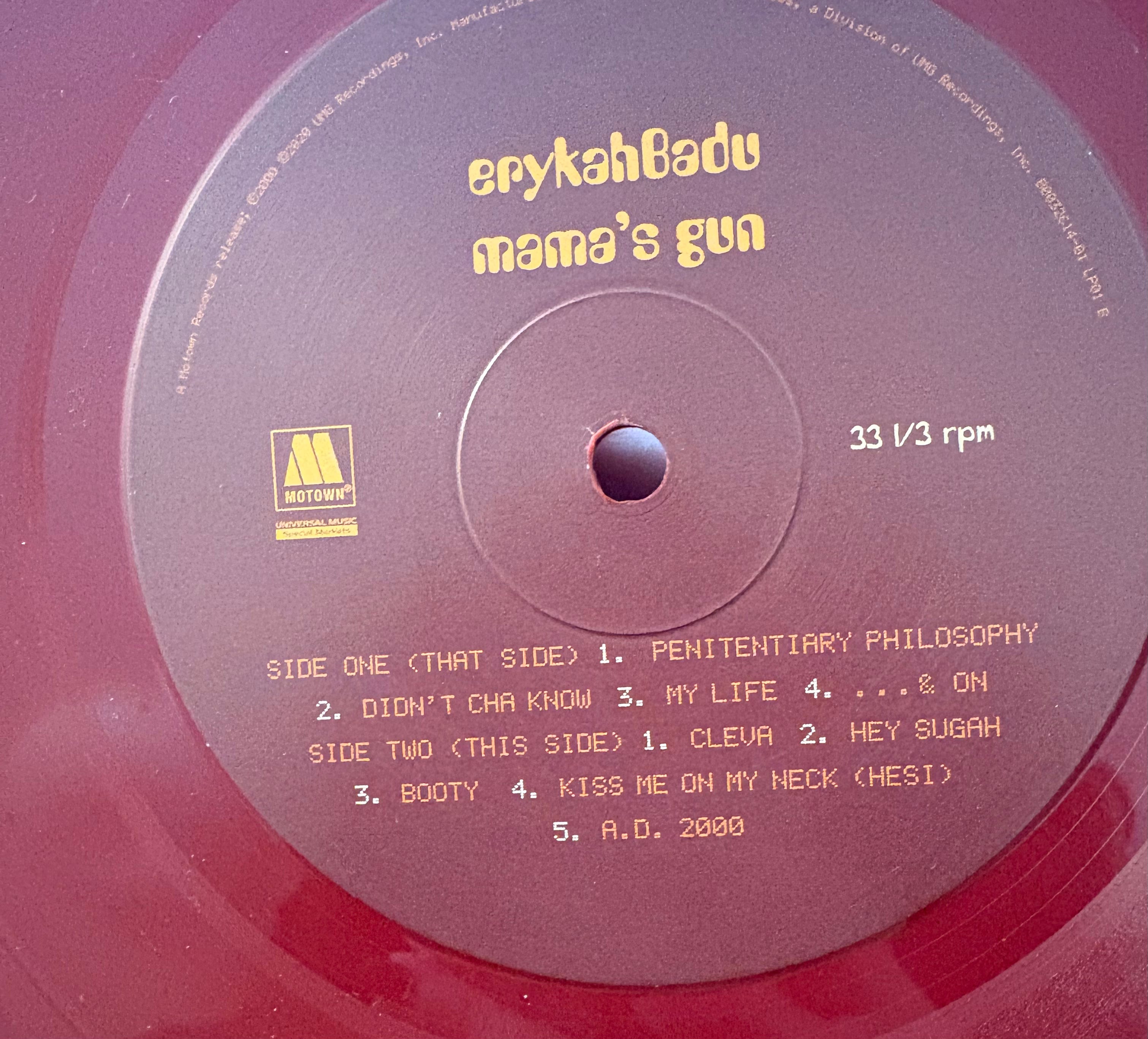
Starting midway through is pretty annoying for the concept of, you know, listening to an album, but it’s my fault and the record’s long (71 minutes!), so on we go.
Erykah Badu gives us a vocal masterclass in singing differently for different songs: raspy and hushed and seductive and confident and loud and commanding in all the right places. Just look at “Cleva” and “Booty” next to each other — there’s an impressively wide gulf in vocal expression and intent between them.
At first, I thought those were the opening tracks (whoops). But when you actually start on Side 1, you’re immediately walloped with purpose. The gritty, soulful “Penitentiary Philosophy” is present and commanding, weighted with significance.
I was spellbound by the gentle insistence of “A.D. 2000,” and I adored the scratchy, jazzy opening of “Orange Moon” — the beginning briefly reminds me of Regina Spektor’s early-career upright bass-led songs. “Orange Moon” possesses a rare, slowly unscrolling honestly. The trickle of flute underscores personal ascension, an earnestness that’s almost Broadway, a level of potent clarity (“I reflect the light of my sun”). Her repetition of “how good it is” is a balm, soaring and praising, as the piano stamps vitally, cutting sun-rays behind her.
How I got it: Vinyl Me, Please membership that I gifted Jake. It’s a double LP — one record is red, and one’s yellow.
When I first listened to it: Right now